 Skip to content

A One-Day Gorilla Trek from Kigali gives travelers the extraordinary opportunity to leave Rwanda’s capital before sunrise, travel into the volcanic highlands of northern Rwanda, trek through mountain forest in search of a habituated gorilla family, spend one unforgettable hour watching mountain gorillas and return to Kigali later the same day.
It is one of Rwanda’s most efficient wildlife experiences, but it is not an ordinary sightseeing excursion.
The day begins extremely early. The journey from Kigali to the Volcanoes National Park region takes roughly three hours in official Visit Rwanda itineraries, and gorilla trekkers must report for registration at 7:00 a.m.
That means breakfast may happen in a safari vehicle while Kigali is still sleeping.
Later, instead of watching wildlife from behind the windows of a safari vehicle, you walk into a mountain forest with professional park guides and trackers. The path may be dry and relatively easy or muddy, steep and physically demanding. Nobody knows exactly how far the gorillas will have moved that morning.
Eventually, the trackers slow down.
The forest becomes quieter.
A ranger may signal that your gorilla family is nearby.
Then an enormous silverback, playful juvenile, watchful female or tiny infant appears through the vegetation.
For the next hour, the long drive, early alarm and muddy trail suddenly feel unimportant.
This guide explains precisely what to expect from a One-Day Gorilla Trek from Kigali, including the pickup time, Rwanda gorilla permit price, road journey, park briefing, trekking difficulty, gorilla encounter, clothing, fitness requirements, photography, porter services, weather conditions, return journey and important considerations for travelers with international flights.
One-Day Gorilla Trek from Kigali: Is It Really Possible?
Yes.
Rwanda is one of the easiest mountain gorilla destinations to access from a national capital.
Volcanoes National Park lies in northwestern Rwanda, near Musanze and Kinigi. Official Visit Rwanda itineraries commonly allow approximately three hours for the road journey between Kigali and the Volcanoes region.
That relatively short distance is what makes a same-day gorilla safari practical.
In some wildlife destinations, reaching a remote park requires an internal flight, a long overland journey or multiple nights away from the main international gateway. Rwanda gives travelers a different option.
You can sleep in Kigali, leave before sunrise, trek gorillas that morning and return to Kigali that evening.
There is, however, one important condition: you must leave early enough.
Rwanda Development Board currently requires mountain gorilla visitors to report to the visitor registration centre at 7:00 a.m.
A normal breakfast-time departure from Kigali therefore does not work.
Depending on your hotel’s location and road conditions, private day trips generally begin around 3:30 to 4:30 a.m. Current competing one-day itineraries show similar departure windows.
It is a long day.
But for business travelers, conference visitors, couples with limited time, solo travelers, East Africa safari guests or visitors already staying in Kigali, it can be a remarkably effective way to experience mountain gorillas without adding another hotel night.
Why Choose a One-Day Gorilla Trek from Kigali?
The biggest advantage is efficiency.
A conventional Rwanda gorilla safari may include one night in Kigali followed by one or two nights near Volcanoes National Park. That is comfortable, but not every traveler has several days available.
A One-Day Gorilla Trek from Kigali removes the extra Volcanoes National Park overnight.
You still complete the official mountain gorilla tracking experience. You still attend the park briefing. You still trek with professional guides and trackers. You still spend the permitted hour with a habituated gorilla family.
What changes is the road schedule.
Instead of traveling north one afternoon, sleeping close to Kinigi and trekking the following morning, you make the Kigali–Volcanoes journey before dawn.
After trekking, you drive back to Kigali instead of checking into a lodge.
The one-day option therefore works especially well when time matters more than avoiding an early morning.
It also makes sense for travelers who have already paid for a Kigali hotel and prefer not to move luggage between accommodations.
A private vehicle can collect you directly from your hotel and bring you back to the same location later.
For some visitors, that simplicity is more valuable than having an extra night near the park.
One-Day Gorilla Trek from Kigali: What the Morning Feels Like
The first surprise is how quiet Kigali feels.
At 3:30 or 4:00 in the morning, the city is very different from the lively capital you see during daylight hours.
The hotel reception may be almost silent.
Your breakfast may already be packed.
The safari vehicle waits outside while streetlights illuminate nearly empty roads.
There is usually not much conversation during the first few minutes.
Everyone is still waking up.
Then the city begins disappearing behind you.
As your vehicle travels north, Rwanda’s hills become more visible.
The sky gradually changes.
People begin appearing along the road.
Small communities wake up.
Farmers start moving toward their fields.
The landscape becomes increasingly dramatic as you approach northern Rwanda.
On a clear morning, volcanic peaks may appear ahead.
This journey is not simply dead time between Kigali and the gorillas.
It provides an introduction to rural Rwanda and helps explain why the country is known as the Land of a Thousand Hills.
By the time you reach Musanze and continue toward Kinigi, the early alarm begins feeling worthwhile.
One-Day Gorilla Trek from Kigali: Complete Day Schedule
No responsible tour operator should guarantee an exact finish time because gorilla movements determine the length of the trek.
However, understanding the general sequence helps you prepare.
One-Day Gorilla Trek from Kigali: 3:30–4:30 AM Pickup
Your driver-guide collects you from your Kigali hotel, residence or agreed location.
You should already be dressed in trekking clothes.
Your boots should be ready.
Your camera batteries should be charged.
Your passport or required identification should be accessible.
If your hotel can provide an early breakfast box, arrange it the evening before.
Do not wait until 3:45 a.m. to discover that your waterproof jacket is inside the suitcase you already packed at the bottom of the luggage pile.
The safari vehicle then leaves Kigali and heads north toward Musanze.
A private transfer is particularly useful because you do not waste time collecting unrelated travelers at several hotels.
The Pre-Dawn Drive Toward Volcanoes National Park
The drive generally takes around two and a half to three hours depending on your departure point, traffic, weather and exact park destination. Official Visit Rwanda itineraries use approximately three hours for Kigali–Volcanoes transfers.
The road climbs through Rwanda’s hilly countryside.
As sunrise approaches, visibility improves and the journey becomes increasingly scenic.
Your driver-guide may discuss the morning procedure, gorilla behavior, Rwanda’s conservation program and the terrain you are likely to encounter.
This is also the time to mention any concerns about your fitness.
If you would prefer consideration for a potentially less demanding trek, your guide should know before arriving at the park.
Arriving at Kinigi for Registration
The activity begins around the Volcanoes National Park headquarters area at Kinigi.
Rwanda Development Board states that visitors should report at 07h00.
Around you are travelers who may have come from Kigali, Musanze or nearby luxury lodges.
Safari vehicles arrive.
Park personnel coordinate the morning.
Guides communicate with staff.
Visitors prepare cameras, adjust clothes and finish breakfast.
Excitement increases because this is the point where the road journey turns into a wildlife experience.
Gorilla Trekking Briefing
Before entering the forest, visitors receive instructions explaining the rules and behavior expected around gorillas.
These guidelines are not simply tourism formalities.
Mountain gorillas are wild primates, and carefully controlled tourism is essential to reducing disturbance and disease transmission.
RDB currently specifies a maximum of eight visitors per trekking group and a maximum viewing period of one hour once the gorillas are reached. Visitors are also instructed to keep an appropriate distance, keep voices low and follow guides’ directions.
Listen carefully even if you have already read dozens of gorilla trekking blogs.
Conditions and instructions given by the official park guides on the day take priority.
Gorilla Family Allocation
Different habituated gorilla families occupy different areas.
Some may be relatively close to accessible trailheads.
Others may have moved higher or deeper into the forest.
Your trekking allocation therefore matters.
Park personnel organize groups according to operational considerations, including physical ability where possible.
If you are an older traveler, have limited mobility or are worried about a very demanding trek, communicate that clearly.
Your tour operator can help make your situation known.
However, there is an important difference between requesting a potentially easier group and being guaranteed an easy trek.
No operator controls where a wild gorilla family moves overnight.
A family that was close yesterday may be farther away today.
Anyone promising an exact 30-minute gorilla walk weeks in advance is promising something nature does not control.
Transfer to the Trailhead
After allocation, you normally return to the safari vehicle and continue toward the relevant starting point.
The trailhead depends on the gorilla family you have been assigned.
Some drives pass through villages and cultivated landscapes before reaching the edge of the park.
This final transfer is often when nervous excitement peaks.
You are no longer simply traveling toward Volcanoes National Park.
You are about to walk into it.
One-Day Gorilla Trek from Kigali: Hiring a Porter
When porters are available at the trekking start, seriously consider hiring one.
A porter can carry your backpack, water, camera equipment and rain gear while also providing useful assistance across steep or slippery sections.
Official Visit Rwanda itineraries specifically note that porters are available to assist trekkers at the trailhead.
Strong hikers sometimes assume they do not need help.
That decision may feel different after two hours of climbing through wet vegetation at altitude.
A small backpack that feels light in the parking area can become surprisingly heavy when you are negotiating mud, roots and slopes.
There is also a wider benefit.
Porter employment connects local communities directly to gorilla tourism.
Hiring a porter therefore improves your physical comfort while supporting people living around the conservation landscape.
The objective is not to prove that you can carry everything yourself.
The objective is to arrive at the gorillas comfortable enough to appreciate the encounter.
One-Day Gorilla Trek from Kigali: Entering the Forest
The landscape changes as trekking begins.
Some routes initially cross cultivated land close to local communities.
You may walk beside fields while the volcanic mountains rise ahead.
Then you reach the park environment.
The vegetation becomes thicker.
Bamboo appears.
The trail becomes less predictable.
Roots, vines, mud and plants begin replacing the open agricultural paths.
Volcanoes National Park is a genuine mountain environment, not a landscaped wildlife attraction.
That distinction matters.
One of the reasons gorilla trekking feels so different from a conventional safari is that you physically enter the animal’s habitat.
There is no vehicle around you.
You hear footsteps, birds, insects and vegetation moving.
You notice changes in temperature and humidity.
The forest may feel cool when you stop and surprisingly warm once you begin climbing again.
At certain points trackers may communicate with the ranger leading your group.
People become quiet.
You begin wondering whether every movement in the vegetation means gorillas are nearby.
Usually, it does not.
Then eventually the mood changes.
The trackers know you are getting close.
One-Day Gorilla Trek from Kigali: What Happens When Gorillas Are Found?
The transition can happen quickly.
One moment you are hiking.
The next, a ranger signals the group to slow down.
Walking sticks may be left behind.
Backpacks may stay with porters.
Cameras come out.
Voices become quieter.
Then you move through vegetation and suddenly see dark fur.
Your first gorilla might be partly hidden.
Perhaps a female sits quietly eating leaves.
A juvenile may be moving through vegetation.
Then the silverback appears.
Or perhaps the silverback is the first animal you see.
Photographs cannot fully prepare travelers for scale.
A mature silverback feels far more impressive in the forest than on a screen.
Yet what often surprises visitors most is not aggression or power.
It is calmness.
The gorillas continue with ordinary life.
They feed.
Rest.
Groom one another.
Young gorillas may play.
Mothers care for infants.
The silverback may sit quietly while monitoring what happens around him.
They are not performing for tourists.
That is exactly what makes the experience extraordinary.
Spending One Hour With Mountain Gorillas
Once the assigned gorilla family has been located, the official viewing period is limited to one hour.
Before the trip, an hour can sound generous.
During the encounter, it passes extremely quickly.
At first many visitors concentrate heavily on photographs.
Phones come out.
Camera settings are checked.
People try to capture the silverback, a mother with an infant or juveniles playing.
After a few minutes, many travelers begin lowering their cameras.
They realize that watching directly is just as important.
A gorilla may carefully strip leaves from a plant.
An infant may climb onto its mother’s body.
A juvenile may suddenly move across an open space.
The silverback may barely move for ten minutes and then change position completely.
Every family behaves differently.
Every day is different.
The forest light is different.
The animals’ positions are different.
That unpredictability is why one person’s gorilla photographs never reproduce another person’s actual experience.
How Close Do You Get to Mountain Gorillas?
RDB’s current visitor guidelines call for maintaining approximately seven metres from the gorillas.
Visitors should respect that guidance.
However, gorillas do not understand measuring tapes.
A gorilla may choose to move closer.
If that happens, do not reach out.
Do not run.
Do not suddenly jump into a new position because you want a better photograph.
Follow the ranger’s instructions.
Park guides work with the habituated gorilla families regularly and understand their behavior far better than a visitor spending one morning in the forest.
If a silverback moves toward your group, the correct response is not improvisation.
Stay calm and listen.
One-Day Gorilla Trek from Kigali: Gorilla Trekking Difficulty
“How difficult is the trek?” is one of the questions travelers ask most frequently.
There is no single answer.
A gorilla trek may involve a relatively gentle walk.
Another traveler on another day may spend several hours climbing through muddy mountain forest.
Current one-day safari pages typically describe anything from shorter walks to treks lasting several hours because the animals’ location changes continuously.
The important variables include the location of your assigned gorilla family, terrain, rainfall, altitude, vegetation and your personal fitness.
The return walk also counts.
Finding the gorillas is not the end of the physical activity.
After your one-hour encounter, you still need to walk back to the trailhead.
For most reasonably active travelers, gorilla trekking is manageable.
You do not need to train like a mountaineer.
But describing the experience as an effortless nature walk would also be misleading.
Preparing Your Fitness Before Gorilla Trekking
Simple preparation can make a large difference.
If your trip is several weeks away, walk regularly.
Choose routes with hills.
Use stairs.
Spend time in the boots you intend to wear.
Gradually become comfortable walking for a few hours.
Gym fitness helps, but trail fitness can feel different.
A person who regularly lifts weights but never walks on uneven ground may be less comfortable than someone who takes long weekend walks.
You do not need extraordinary speed.
In fact, rushing is rarely useful.
Mountain trekking at altitude rewards a steady pace.
Hydrate.
Listen to the guide.
Ask for a pause if you genuinely need one.
There is no competition for who reaches the gorillas first.
The group experiences the encounter together.
One-Day Gorilla Trek from Kigali for Travelers in Their 60s and 70s
Older travelers successfully trek gorillas every year.
Age alone is not the most important factor.
Mobility, fitness, balance and general health matter much more.
An active traveler in their seventies may perform far better than a sedentary traveler decades younger.
If you regularly walk, climb stairs and remain comfortable on uneven ground, age should not automatically discourage you.
However, significant mobility limitations deserve realistic consideration.
Tell Universal Ventures Rwanda before booking if a traveler has difficulty walking long distances, climbing slopes or maintaining balance.
The information can help with planning and communication during group allocation.
Travelers with medical concerns should seek appropriate medical advice about whether hiking at altitude is suitable for them.
A safari operator can help with logistics, but medical clearance belongs with a qualified healthcare professional.
One-Day Gorilla Trek from Kigali Permit Cost in 2026
The standard Rwanda mountain gorilla permit for a foreign visitor is currently US$1,500 per person per trek.
This figure comes directly from Rwanda Development Board’s live permit portal and Visit Rwanda.
The minimum trekking age is 15 years.
RDB also displays special categories for qualifying residents, Rwandan citizens, East African citizens and other eligible travelers. Some of those rates are promotional and have date-specific restrictions, so travelers who believe they qualify should verify the conditions that apply at the time of booking rather than relying on an old blog article.
For most international visitors researching Rwanda gorilla trekking, the US$1,500 standard permit is the figure they should use when estimating the basic cost.
The permit is not the same as the total price of a complete one-day safari.
You also need transportation, fuel, guiding, meals and operational logistics unless your package explicitly includes them.
What Does the Rwanda Gorilla Permit Include?
Think of the gorilla permit as authorization for the regulated tracking experience.
It gives the permit holder access to the official gorilla trek on the confirmed date, subject to RDB rules and documentation requirements.
Once your family is found, the permit allows the regulated one-hour encounter.
It does not automatically pay for your private vehicle from Kigali.
It does not automatically include your hotel.
It does not automatically cover your lunch, porter, personal expenses or travel insurance.
This distinction is crucial when comparing safari quotations.
A tour advertised for US$300 or US$400 may simply represent private transport and guiding while requiring you to purchase the US$1,500 permit separately.
Another company may quote US$1,900 or US$2,000 with the permit included.
Those prices cannot be compared until you understand what each includes.
Always read the package details.
Booking the Gorilla Permit
RDB states that permits can be booked in advance and that bookings are handled on a first-come, first-served basis.
This makes the permit the first item to consider once your dates are becoming firm.
A safari vehicle can often be found more easily than a sold-out trekking slot.
This matters even more for groups.
A solo traveler needs one permit.
A couple needs two.
A group of six needs six permits on the same date.
The more people traveling together, the more important early confirmation becomes.
Travelers can book through the official system or arrange permits through an operator. Visit Rwanda specifically notes that visitors may book through licensed tour operators as part of a package containing permits and logistics.
For a One-Day Gorilla Trek from Kigali, having one operator coordinate both permit and transportation simplifies the entire process.
Passport Details and Gorilla Permits
Permit documentation deserves careful attention.
RDB warns that incorrect, incomplete or false applications can result in entry being denied even if the applicant has paid and received a system-generated permit.
Make sure the details you provide are correct.
If your passport is being renewed, tell your tour operator.
If you will travel using a different passport from the one you initially expected, address that before permit arrangements are finalized.
Do not casually enter incorrect information because you assume somebody will correct it at the park.
A US$1,500 trekking date is not the right place for avoidable documentation problems.
One-Day Gorilla Trek from Kigali: Minimum Age
Rwanda’s current minimum age for mountain gorilla tracking is 15 years.
This matters especially for families.
Parents cannot simply purchase permits and assume a younger child will be allowed to join.
Families traveling with children under 15 should organize alternative supervision and activities while eligible family members trek.
Teenagers who meet the age limit should still understand the physical demands.
A 15-year-old who is active and comfortable outdoors may love the adventure.
Another teenager who dislikes walking, mud or early mornings may find the experience much harder.
Age eligibility and physical readiness are different questions.
One-Day Gorilla Trek from Kigali Packing Guide
Packing correctly can turn a difficult trek into a comfortable one.
Fortunately, you do not need a complicated expedition kit.
Start with footwear.
Visit Rwanda recommends solid walking shoes, gaiters, sturdy clothing, gloves and lightweight waterproof protection.
Hiking boots with good traction are ideal.
The forest may be wet even when Kigali was dry.
Mud, roots and sloping ground reward footwear designed for outdoor walking.
Wear long trousers rather than shorts.
Long fabric helps protect your legs against vegetation, insects and mud.
A long-sleeved top protects your arms.
Gardening or outdoor gloves can be surprisingly valuable when you need to steady yourself near thick vegetation.
Carry a lightweight rain jacket even when the forecast looks favorable.
Mountain weather can change quickly.
A small daypack is enough.
Bring water, essential medication, your phone or camera and appropriate identification.
Avoid filling your bag with items you will never use.
Every extra kilogram eventually has to travel uphill.
Footwear for Gorilla Trekking
Do not underestimate boots.
The difference between good trekking footwear and smooth everyday sneakers becomes obvious very quickly when the trail is muddy.
Choose boots with reliable grip.
Ankle support can help on uneven ground.
Most importantly, wear them before coming to Rwanda.
Brand-new boots that have never been tested may cause blisters during the one day when you desperately need comfortable feet.
If you purchase new trekking footwear specifically for Rwanda, start walking in it several weeks before departure.
Your feet will thank you.
What to Wear When Leaving Kigali Before Dawn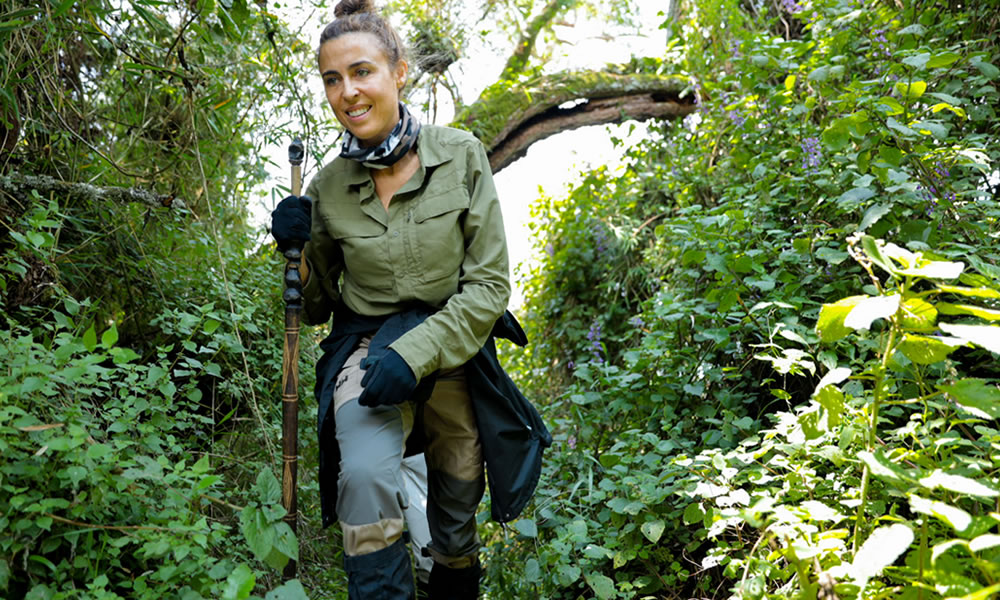
The challenge of a one-day trek is that you experience several environments in one day.
Kigali may feel mild.
The pre-dawn vehicle may feel cool.
The Volcanoes region may be cooler still.
Once hiking uphill, your body quickly warms.
Layering solves the problem.
Wear a comfortable base layer and long-sleeved outdoor shirt.
Carry a waterproof outer layer.
Avoid overly heavy clothing that becomes uncomfortable once you begin climbing.
Choose practical clothes that can become muddy.
This is not the day for trousers you are afraid to stain.
The forest will not adjust itself to your wardrobe.
One-Day Gorilla Trek from Kigali Photography Tips
Mountain gorilla photography is exciting because the animals may be relatively close.
It is also technically challenging.
The forest can be dark.
Mountain gorillas have very dark fur.
Vegetation creates patches of bright light and deep shadow.
Animals move unpredictably.
You may have only seconds to photograph a juvenile crossing an opening.
A modern smartphone can produce excellent memories.
Do not assume professional camera equipment is necessary.
If you bring a dedicated camera, use equipment you already understand.
You do not want to spend your one permitted hour navigating unfamiliar menus.
Protect camera equipment from rain.
Bring enough battery power and storage.
If your camera bag is heavy, hire a porter.
Most importantly, remember that photography is not the only objective.
Take the pictures.
Then lower the camera.
Watch.
You crossed continents and walked through a mountain forest to see gorillas with your own eyes, not only through a screen.
One-Day Gorilla Trek from Kigali Health Rules
Gorilla tourism has strict health considerations because humans and great apes can share disease risks.
RDB states that visitors may be denied access if they are sick with a cold, flu or another contagious illness.
If you need to cough while around gorillas, official rules instruct you to turn away and cover your mouth.
These precautions can be disappointing if illness interferes with a long-planned safari, but the conservation logic is straightforward.
The health of a gorilla family is more important than one individual’s travel schedule.
Visitors should therefore take reasonable precautions before trekking, follow the current instructions at briefing and never hide significant symptoms simply to avoid losing an experience.
What If a Gorilla Approaches You?
Remain calm.
Do not run.
Do not reach toward the animal.
Do not treat close proximity as permission to touch it.
Follow the ranger.
RDB guidance explains that visitors should remain still and follow the guide’s instructions if a gorilla displays or vocalizes.
This is one of the reasons trekking is led professionally.
You do not need to understand every gorilla gesture.
The rangers do.
Your responsibility is to cooperate.
Can You Touch Mountain Gorillas?
No.
Gorilla trekking is an observation experience.
It is not an interactive wildlife attraction.
Even if a gorilla chooses to move nearby, visitors should not intentionally touch it.
The most powerful part of the experience is precisely that these are wild animals living within their own environment.
Respecting distance helps keep that relationship intact.
One-Day Gorilla Trek from Kigali in the Rainy Season
Rain should not automatically discourage you.
Volcanoes National Park is lush because rainfall is part of the ecosystem.
The biggest difference during wetter conditions is underfoot.
Trails may become muddier.
Steep sections can feel more slippery.
Waterproof clothing, gaiters and good boots become even more important.
Rain can also create beautiful photographic conditions.
Mist can move across the volcanic landscape.
Vegetation becomes intensely green.
Clouds soften harsh light.
The challenge is not rain itself.
The challenge is arriving unprepared for it.
A small waterproof jacket weighs very little compared with how valuable it becomes during a sudden mountain shower.
One-Day Gorilla Trek from Kigali During Drier Months
Drier periods can provide easier trail conditions, which is one reason many travelers prefer them.
But “dry season” does not mean “guaranteed dry trek.”
This is a highland environment.
Rain can occur.
Mud may remain from previous weather.
Mountain conditions can change quickly.
Another factor is demand.
Popular travel months can place more pressure on permit availability.
If your trip falls during a busy period, do not assume you can buy permits shortly before arrival.
Weather is only one part of planning.
Permit availability usually matters more.
Best Time for Gorilla Trekking in Rwanda
Mountain gorilla tracking takes place throughout the year.
There is therefore no single short season in which travelers are allowed to see gorillas.
Different months simply create different trekking conditions.
If your primary goal is to experience gorillas, choose dates that fit your broader African itinerary and secure the permit.
Then prepare appropriately for the likely conditions.
Travelers combining Rwanda with Kenya or Tanzania may naturally choose months that work well for the broader safari.
Visitors attending a conference in Kigali may have only one possible day.
Both can still have an excellent gorilla experience.
One-Day Gorilla Trek from Kigali for Solo Travelers
Solo travel works well in Rwanda.
You can book a private vehicle from Kigali even if you are traveling alone.
The main difference is cost.
A couple divides the private transport cost between two people.
A solo traveler carries that cost alone.
The gorilla permit, however, remains based on the applicable individual visitor category.
Also understand what “private safari” means.
Your road transfer can be private.
Your driver-guide can work only with you.
But once at the park, you ordinarily join the official trekking group assigned to the gorilla family.
RDB currently limits that group to a maximum of eight visitors.
A private vehicle and a private gorilla family encounter are therefore not automatically the same product.
One-Day Gorilla Trek from Kigali for Couples
Couples are particularly well suited to the one-day private format.
Transportation costs are shared while you maintain control over the road itinerary.
Your driver collects you from your own hotel.
There is no need to wait while unrelated passengers are picked up from other properties.
After trekking, your lunch and return schedule can respond to the length of your own trek.
For honeymooners with a longer Rwanda itinerary, staying near Volcanoes National Park may still feel more romantic and relaxed.
But couples passing through Kigali for a short visit can complete the gorilla experience very efficiently in one day.
One-Day Gorilla Trek from Kigali for Families
Families can trek together when everyone meets the minimum age requirement.
Current RDB rules set that minimum at 15 years.
Before booking, consider more than age.
Does each teenager enjoy hiking?
Are they comfortable with mud?
Can they manage several hours of walking?
Will a 3:30 a.m. wake-up make them miserable before the trek even starts?
Families often benefit from discussing the experience honestly in advance.
If younger children are traveling, arrange suitable supervision during the trek rather than trying to improvise after arriving at Kinigi.
One-Day Gorilla Trek from Kigali for Business and Conference Travelers
Kigali regularly receives international business visitors and conference participants.
For them, time is often the main constraint.
A traveler may have meetings until Friday evening and only Saturday free before flying home.
A one-day gorilla trek transforms that limited free day into a substantial wildlife experience.
You do not need to relocate to a lodge for several nights.
You can leave your luggage in Kigali, trek and return.
However, fixed business schedules make permit planning even more important.
A leisure traveler may shift their trek from Tuesday to Thursday.
A conference attendee with only Saturday available cannot.
Check permits early.
One-Day Gorilla Trek from Kigali Airport
Travelers arriving through Kigali International Airport often ask whether they can go directly to Volcanoes National Park.
The answer depends on arrival time.
If you arrive in Kigali during the afternoon or evening before trekking, airport pickup can easily be integrated into the itinerary.
You may either stay in Kigali or continue toward the Volcanoes region depending on your preference and schedule.
Trying to land immediately before the morning gorilla trek is much more risky.
Immigration takes time.
Baggage collection takes time.
Flights get delayed.
The park still operates on its morning schedule.
The safer arrangement is normally to arrive in Rwanda the previous day.
Can You Arrive in Kigali and Trek Gorillas the Same Morning?
It may look possible on paper when a flight arrives extremely early.
It is usually a poor plan.
RDB requires trekkers to report at 7:00 a.m. and explicitly states that no refund is made for late arrival or flight delay.
That matters.
If your airline lands late, the gorilla program does not simply wait.
If immigration takes longer than expected, the trekking group does not reorganize itself around your baggage collection.
Protect your US$1,500 permit by arriving in Rwanda the day before.
The small cost of an extra night in Kigali can provide significant peace of mind.
Can You Fly Out After a One-Day Gorilla Trek from Kigali?
Sometimes, but flight time matters.
The problem is not the road distance alone.
The problem is that nobody can guarantee what time you will leave the forest.
Imagine your gorilla family is located relatively close to the trailhead.
You may finish early.
Now imagine the family has moved significantly farther into the mountains.
The entire day shifts later.
Then you still need to return to the vehicle, travel toward Kigali and complete airport check-in.
An afternoon international flight is therefore risky.
A sufficiently late evening flight may be possible depending on the schedule.
Send Universal Ventures Rwanda your airline, flight number and departure time before finalizing the trek.
The itinerary can then be assessed realistically rather than based on hope.
What Time Does a One-Day Gorilla Trek Return to Kigali?
There is no guaranteed return hour.
Some operators provide estimated times, which are useful for planning.
They should remain estimates.
Your finishing time depends on the gorillas.
Weather can affect walking speed.
Lunch timing can change.
Road conditions and Kigali traffic can influence the return journey.
Reserve the entire day.
Do not schedule an important business meeting, restaurant reservation or flight around the assumption that your vehicle will reach Kigali at exactly 4:00 p.m.
A wildlife experience should be allowed to operate like a wildlife experience.
Lunch After Gorilla Trekking
After several hours in the forest, lunch feels well deserved.
Depending on your safari package, your driver-guide may take you to a restaurant or lodge around Kinigi or Musanze.
The meal should remain flexible rather than tied to an exact reservation time.
If you finish trekking quickly, you eat earlier.
If the gorillas required several hours of hiking, lunch moves later.
This is also when the experience begins sinking in.
People compare photographs.
They talk about the silverback.
Someone remembers an infant they almost forgot to photograph.
Mud is drying on boots.
The intense focus of the trek gives way to satisfaction.
Then you begin the journey back to Kigali.
The Return Drive to Kigali
The return journey feels completely different from the morning transfer.
You are no longer watching the clock.
You have already completed the trek.
Northern Rwanda is fully visible in daylight.
Villages, farms and hills that were hidden in darkness during the outbound journey now pass clearly outside the window.
Some travelers talk continuously.
Others fall asleep almost immediately.
Both reactions are normal.
Gorilla trekking combines a very early start with physical exertion and emotional excitement.
By the time you reach Kigali, the day may feel much longer than the number of hours suggests.
One-Day Gorilla Trek from Kigali vs Two-Day Gorilla Safari
Neither option is automatically better.
They serve different travelers.
The one-day tour prioritizes time and efficiency.
You avoid an additional Volcanoes National Park hotel night.
You can keep your Kigali accommodation.
You compress transportation and trekking into one day.
The disadvantage is the early wake-up and long road schedule.
A two-day gorilla safari changes the pace completely.
You leave Kigali during daylight the day before trekking.
You travel comfortably to Musanze or Kinigi.
You check into a lodge.
You have dinner.
You sleep near the park.
Trekking morning begins much later because you no longer have a three-hour transfer before briefing.
After trekking, you can relax before returning to Kigali.
Travelers who value comfort should consider two days.
Travelers who value time should seriously consider one day.
The core regulated gorilla encounter is not reduced simply because you started in Kigali.
One-Day Gorilla Trek from Kigali vs Staying in Musanze
Staying in Musanze or near Kinigi removes the most demanding logistical element: the pre-dawn drive.
You can have a more conventional breakfast and arrive at park headquarters after a short transfer.
That is particularly attractive to older travelers, honeymooners and anyone recovering from a long international journey.
Starting from Kigali makes more sense when you already have accommodation in the city or cannot justify another night.
The decision comes down to pace.
If your itinerary has flexibility, an overnight near the park is comfortable.
If Rwanda is a short stop during a wider African journey, Kigali provides excellent access without requiring a multi-day detour.
Why Rwanda Works So Well for Short Gorilla Safaris
Rwanda’s geography is a major advantage.
The country’s main international gateway and its mountain gorilla destination are connected by road.
You do not need to fly domestically.
You do not need to cross an international border.
You do not need to spend a day just positioning yourself for trekking.
That convenience helps explain why current search results contain so many one-day Kigali gorilla packages. SafariBookings alone currently lists dozens of one-day Rwanda gorilla trekking options.
For a traveler comparing limited vacation time, that accessibility is powerful.
Rwanda Gorilla Trekking and Conservation
Gorilla trekking should never be viewed only as an expensive wildlife photo opportunity.
The experience exists within a tightly controlled conservation system.
Visitor numbers are limited.
Viewing time is limited.
Health precautions are enforced.
Habituated groups are monitored.
Visitors trek with trained park personnel rather than independently.
The restrictions can sometimes feel strict to travelers paying a significant permit fee.
But that is exactly the point.
A mountain gorilla experience should not function like mass tourism.
The long-term objective is for gorillas to remain protected while tourism produces economic value that helps sustain conservation and nearby communities.
Responsible tourism means accepting that the gorillas’ welfare comes first.
Why Only One Hour With the Gorillas?
Many travelers naturally want more time.
After paying US$1,500 and walking for several hours, one hour can feel short.
But the experience is designed around the animals, not maximum visitor entertainment.
RDB limits viewing to one hour.
The restriction reduces the amount of continuous tourist exposure experienced by a habituated family.
It also allows park authorities to manage access consistently.
The limit actually contributes to the intensity of the experience.
You know the time is valuable.
You pay attention.
You notice details.
You do not treat the animals like an attraction that can be revisited every fifteen minutes.
What If You Do Not Find the Gorillas?
Professional trackers monitor habituated groups and successful encounters are the normal objective, but these remain wild animals.
RDB publishes a policy for unsuccessful tracking.
Visitors who fail to track gorillas for the whole day because of gorilla-group movement may be offered another opportunity or a full permit refund, while some other unsuccessful-contact scenarios may qualify for a 75% refund under the published rules.
Those policies demonstrate an important truth.
Nature cannot be controlled completely.
That uncertainty is part of what separates a true wildlife encounter from an exhibition.
What Happens If You Are Late?
This is far more preventable.
RDB states that no refund is made in cases of late arrival, flight delay, absence or trip cancellation for other reasons.
That is why your Kigali pickup feels so early.
When a driver says 4:00 a.m., they are not trying to make your holiday unnecessarily difficult.
They are protecting your trekking schedule.
Set two alarms.
Prepare everything the evening before.
Be in the hotel lobby on time.
You can sleep in the vehicle.
You cannot ask an allocated gorilla trekking day to start two hours late.
One-Day Gorilla Trek from Kigali Common Planning Mistakes
The most damaging mistake is leaving permit arrangements until the last moment.
Another is booking a flight too close to trekking time.
A third is assuming the hike will definitely be short.
Some visitors bring unsuitable shoes because they have seen photographs of gorillas sitting in open vegetation and assume the entire experience is an easy walk.
Others bring enormous camera bags they struggle to carry.
Some refuse porter assistance even when mobility is limited.
Another common error is comparing safari prices without checking whether the gorilla permit is included.
A transfer costing a few hundred dollars and an all-inclusive package containing a US$1,500 permit are completely different products.
Read the inclusions.
Ask questions.
Share your flight schedule.
Explain mobility concerns.
Then allow the operator to design the logistics properly.
Is a One-Day Gorilla Trek from Kigali Worth It?
If you only have one available day in Rwanda and mountain gorillas are a priority, the experience can be extraordinarily worthwhile.
You are not purchasing a short zoo visit.
You are traveling into a volcanic landscape and entering wild mountain gorilla habitat on foot.
The difficulty of the journey often adds emotional value.
When the trackers finally locate the family, you know you worked to reach them.
That creates a very different feeling from stepping out of a vehicle beside an attraction.
However, a one-day trek is demanding.
You should choose it because your schedule benefits from the efficiency, not because it is always the most comfortable option.
If you have several days and prefer a slower journey, stay near Volcanoes National Park.
If you have one day and are willing to wake early, Kigali gives you remarkable access.
What Travelers Often Remember Most
The silverback usually dominates expectations.
Yet travelers often remember unexpected details.
The empty Kigali road before sunrise.
The volcanoes appearing through morning cloud.
The nervous energy at Kinigi.
The first muddy section of trail.
A tracker suddenly signaling for silence.
The sound of vegetation moving.
An infant looking toward the group.
A juvenile climbing across another gorilla.
The size of a silverback’s hands.
The forest becoming quiet when everyone stops taking photographs.
Those moments are difficult to capture in a price table.
They are why the experience remains memorable long after the permit cost has been forgotten.
Extending a Gorilla Trek Into a Longer Rwanda Safari
A one-day gorilla tour does not have to be your only Rwanda experience.
Travelers with extra time can add Akagera National Park for savannah wildlife, Nyungwe National Park for chimpanzee trekking and forest experiences, Lake Kivu for relaxation or additional Volcanoes National Park activities.
Golden monkey trekking is particularly convenient for travelers staying an extra night around Musanze.
Lake Kivu can create a relaxing contrast after a demanding mountain trek.
Akagera offers the traditional safari landscapes travelers associate with East Africa.
Nyungwe adds another completely different primate environment.
Rwanda’s relatively compact geography makes these combinations practical when enough days are available.
Combining Gorilla Trekking With Kenya or Tanzania
A One-Day Gorilla Trek from Kigali also works well as an extension to a broader East African safari.
Someone visiting Kenya for the Masai Mara or Tanzania for Serengeti and Ngorongoro can add Rwanda before or after the savannah safari.
The experiences complement one another rather than repeat each other.
In Kenya or Tanzania, you may spend hours inside a safari vehicle watching lions, elephants, giraffes and plains wildlife.
In Volcanoes National Park, you leave the vehicle behind and physically walk into a forest searching for a single primate family.
One is open-country wildlife viewing.
The other is intimate forest trekking.
Together, they create a much broader East African experience.
One-Day Gorilla Trek from Kigali FAQ
How early does a One-Day Gorilla Trek from Kigali start?
Pickup usually occurs very early, commonly around 3:30 to 4:30 a.m., because RDB requires trekkers to report at the visitor registration centre at 7:00 a.m.
Your exact departure time should be confirmed by your operator according to the pickup location and current conditions.
How far is Volcanoes National Park from Kigali?
Official Visit Rwanda itineraries commonly allow about three hours by road for Kigali-to-Volcanoes National Park transfers.
Actual journey time varies with traffic, weather and the exact starting and ending points.
How much is a Rwanda gorilla permit?
The standard permit for a foreign visitor is currently US$1,500 per person per trek.
Is the gorilla permit included in the tour price?
That depends on the package.
Some tour prices include the permit while others advertise transport and guiding separately.
Always request a clear inclusion list.
How old must you be for gorilla trekking in Rwanda?
The minimum age is 15 years.
How many people are in a gorilla trekking group?
RDB currently permits a maximum of eight visitors per group.
How long do you spend with the gorillas?
Once the family is reached, viewing is limited to one hour.
How long does the actual trek take?
There is no fixed time.
It depends on where your allocated gorilla family is located, weather conditions, terrain and the group’s pace.
Expect anything from a relatively short hike to several hours in the forest.
Is gorilla trekking difficult?
It can be.
Terrain may include mud, steep slopes, roots and thick vegetation.
A reasonable level of fitness and proper footwear make the experience easier.
Can older people trek gorillas?
Yes, many do.
Fitness and mobility are usually more important than age alone.
Discuss significant mobility concerns with your operator in advance.
Can I request an easier gorilla trek?
You can communicate your physical ability and ask for consideration during allocation.
However, nobody can guarantee a specific walking distance because gorillas move naturally.
Should I hire a porter?
For most travelers, hiring a porter is a good decision.
Porters can carry equipment and provide assistance on difficult terrain.
What shoes should I wear?
Sturdy hiking or walking shoes with good grip are recommended. Visit Rwanda also recommends gaiters and sturdy clothing.
Should I bring gloves?
Yes.
Gardening or outdoor gloves are useful around thick vegetation and are specifically recommended by Visit Rwanda.
Can I photograph the gorillas?
Yes, while following the park’s current photography and behavior rules.
Listen to ranger instructions and avoid any photography behavior that disturbs the animals.
Can I touch a gorilla?
No.
Maintain the instructed distance whenever possible and follow the ranger if a gorilla chooses to approach.
What happens when it rains?
Rain is a normal part of the Volcanoes National Park environment.
Trekking conditions may become muddier, which makes boots and waterproof protection especially important.
Can I arrive at Kigali Airport and trek that same morning?
It is risky.
The trek operates around a 7:00 a.m. reporting time, and RDB does not refund permits because of flight delay or late arrival.
Arriving the previous day is much safer.
Can I fly out of Kigali after gorilla trekking?
Possibly, if the flight departs sufficiently late.
Because trekking time cannot be guaranteed, avoid tight afternoon connections.
Share your exact flight with the tour operator before confirming.
Can I do gorilla trekking from Kigali without staying near Volcanoes National Park?
Yes.
That is exactly what the one-day itinerary is designed to achieve.
You leave Kigali before dawn and return later the same day.
Should I choose one day or two days?
Choose one day when saving time is the priority.
Choose two days when comfort, relaxation and avoiding the extremely early Kigali departure matter more.
Is gorilla trekking available all year?
Yes, Rwanda mountain gorilla tracking operates throughout the year, subject to permit availability and park operations.
Different seasons mainly change trail and weather conditions.
Can Universal Ventures Rwanda arrange the permit?
Universal Ventures Rwanda offers gorilla trekking services and permit arrangements as part of its Rwanda safari operations. Its website also advertises private safari vehicles, airport transfers and gorilla trekking packages.
Why Book a One-Day Gorilla Trek from Kigali With Universal Ventures Rwanda?
A successful one-day safari depends heavily on organization.
There is little room for avoidable delays.
Your permit needs to be secured correctly.
Your passport details need to match.
The driver-guide needs to arrive on time.
The Kigali departure must be early enough.
The park reporting schedule must be respected.
Lunch needs to remain flexible because trekking time changes.
The return transfer needs to account for your hotel, airport or onward itinerary.
Universal Ventures Rwanda can coordinate these parts into one private journey.
Instead of managing a permit independently, finding transport separately and then trying to make the schedules fit, you can organize the experience around one itinerary.
Private transportation is especially useful for one-day travelers because your safari does not depend on collecting unrelated passengers around Kigali.
If your trip includes an international flight, share the details in advance.
If a traveler has mobility concerns, say so.
If you carry unusually large camera equipment or luggage, mention it.
Good planning begins with accurate information.
Book Your One-Day Gorilla Trek from Kigali
A One-Day Gorilla Trek from Kigali is demanding enough to feel like an adventure and efficient enough to fit inside a surprisingly short Rwanda itinerary.
You begin before sunrise.
You leave Kigali while the city is quiet.
You watch Rwanda’s countryside emerge from darkness.
You reach the volcanic north.
You attend the park briefing.
You step onto the trail.
You walk through farmland, bamboo and mountain vegetation.
Then, after minutes or hours of searching, the trackers slow down.
There is movement ahead.
A mountain gorilla appears.
For the next hour, your schedule no longer matters.
You watch wild gorillas feeding, resting, moving and interacting inside the landscape they have inhabited for generations.
Then the hour ends.
You walk back.
You eat lunch.
You return to Kigali.
By evening, you may be sitting inside the same hotel where you began before dawn.
But the day feels much larger than a simple round trip.
That is what travelers should expect from gorilla trekking in Rwanda: an early start, genuine physical effort, unpredictable forest conditions and one of Africa’s most intimate wildlife experiences.
Contact Universal Ventures Rwanda
For One-Day Gorilla Trek from Kigali bookings, Rwanda gorilla permit arrangements, private transportation and customized Rwanda safari packages, contact Universal Ventures Rwanda.
Email: info@universalventuresrwanda.com
Phone / WhatsApp: +250 781 441 853
Address: KK 15 Road, Opposite IPRC Main Entrance, BGRD Building, Kigali, Rwanda
Website: Universal Ventures Rwanda
